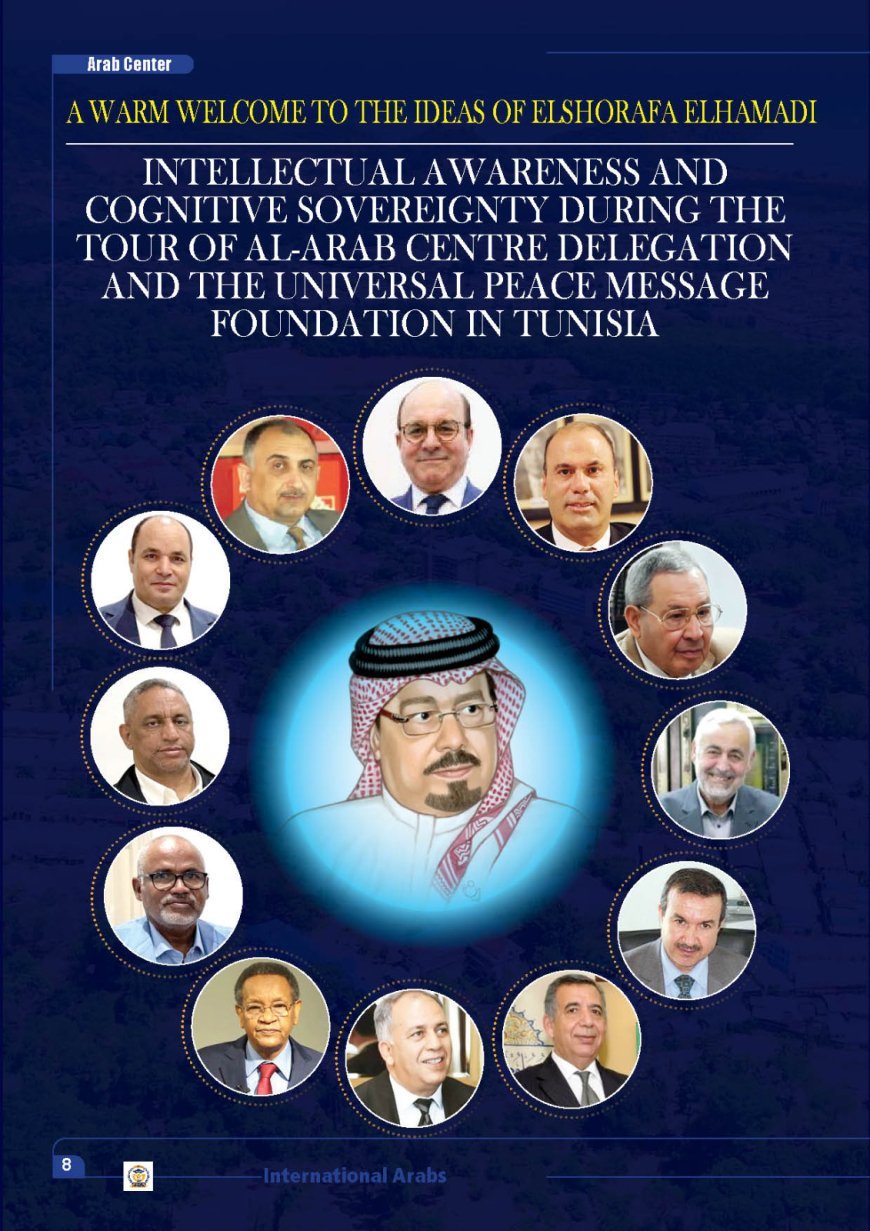
A Warm Welcome to the Ideas of Elshorafa Elhamadi Intellectual Awareness and Cognitive Sovereignty During the Tour of Al-Arab Centre Delegation and the Universal Peace Message Foundation in Tunisia
At this critical historical moment, the Arab world is experiencing intense intellectual and cultural struggles. On one hand, Arab identity faces the challenges of globalization, while on the other hand, it confronts the dangers of extremism and fragmentation. This reality has created an urgent need for cultural and intellectual diplomacy capable of bridging gaps and establishing strong channels of cognitive communication between the eastern and western parts of the Arab world.
From this awareness of the requirements of the era, and during the first half of 2026, the delegation of Al-Arab Centre, in close cooperation with the Digital Library of Elshorafa Elhamadi and the Universal Peace Message Foundation, launched a high-level strategic visit to Tunisia — the cradle of regional intellectual movements and the land of Kairouan and Zaytuna University, deeply rooted in Islamic and enlightening history.
The Enlightenment Bus
This visit, led by journalist and political analyst Mohamed Fathi Elsherif, Head of Al-Arab Centre and General Supervisor of the Digital Library, was not merely a protocol tour. Rather, it resembled the inauguration of a transnational “Enlightenment Bus” carrying a profound intellectual vision formulated by the prominent Arab thinker Ali Mohamed Elshorafa Elhamadi.
This vision is based on purifying Islamic discourse from distortions, reinforcing the concepts of universal mercy, and establishing the values of human coexistence and acceptance of others. These principles resonated strongly with the academic, diplomatic, and political aspirations of Tunisian institutions and intellectual figures, resulting in an enlightening movement that extended over several days through deep discussions, sustainable scientific protocols, and valuable intellectual exchanges.
The Diplomacy of Thought and the Power of Awareness
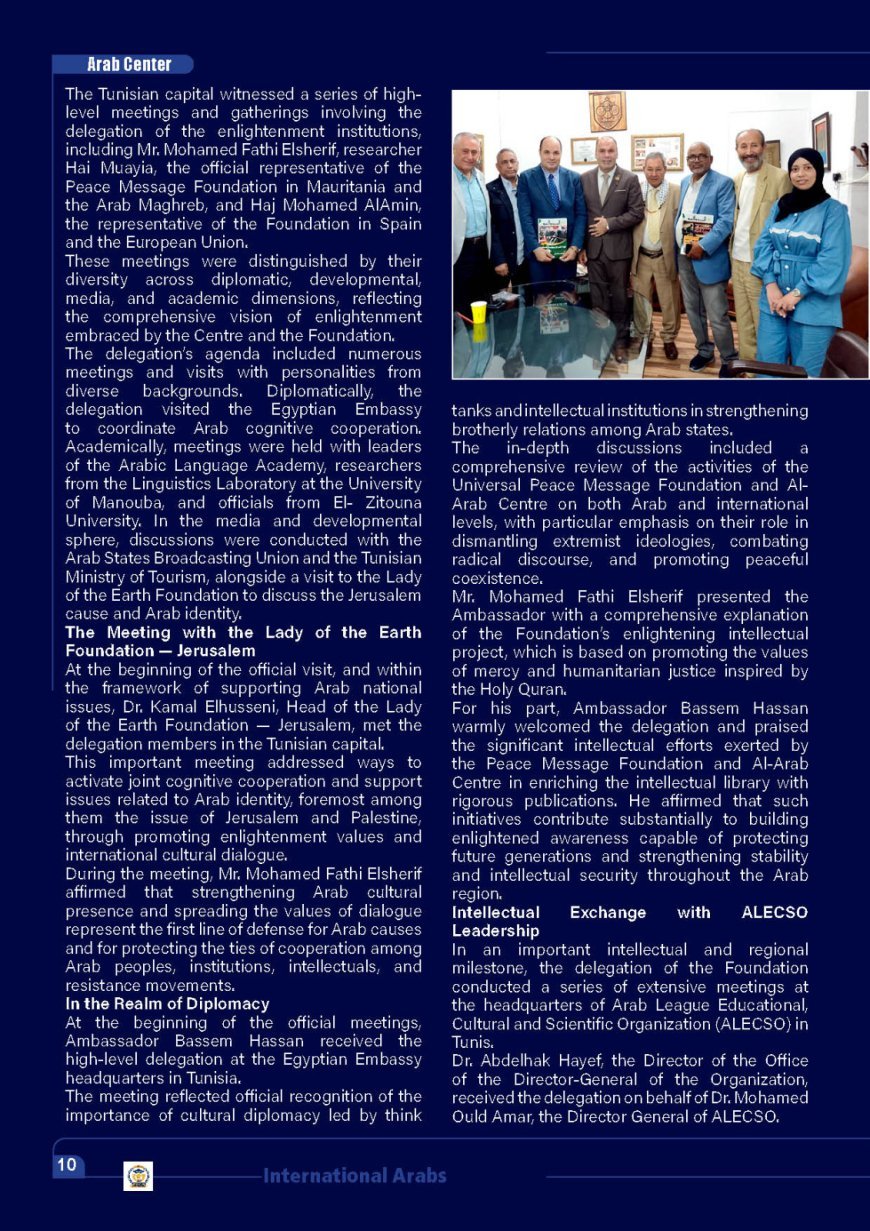
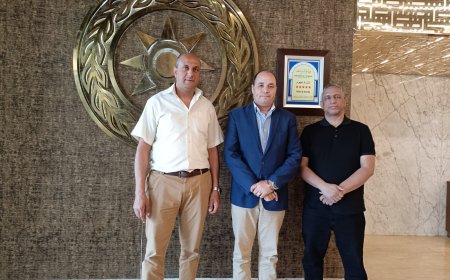
The Tunisian capital witnessed a series of high-level meetings and gatherings involving the delegation of the enlightenment institutions, including Mr. Mohamed Fathi Elsherif, researcher Hai Muayia, the official representative of the Peace Message Foundation in Mauritania and the Arab Maghreb, and Haj Mohamed AlAmin, the representative of the Foundation in Spain and the European Union.
These meetings were distinguished by their diversity across diplomatic, developmental, media, and academic dimensions, reflecting the comprehensive vision of enlightenment embraced by the Centre and the Foundation.
The delegation’s agenda included numerous meetings and visits with personalities from diverse backgrounds. Diplomatically, the delegation visited the Egyptian Embassy to coordinate Arab cognitive cooperation. Academically, meetings were held with leaders of the Arabic Language Academy, researchers from the Linguistics Laboratory at the University of Manouba, and officials from Ez-Zitouna University. In the media and developmental sphere, discussions were conducted with the Arab States Broadcasting Union and the Tunisian Ministry of Tourism, alongside a visit to the Lady of the Earth Foundation to discuss the Jerusalem cause and Arab identity.
The Meeting with the Lady of the Earth Foundation — Jerusalem
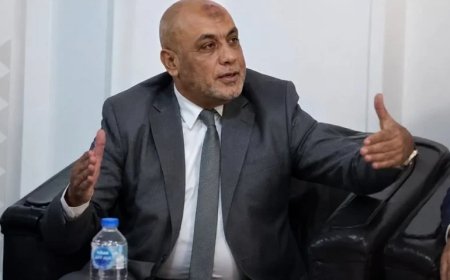
At the beginning of the official visit, and within the framework of supporting Arab national issues, Dr. Kamal Elhusseni, Head of the Lady of the Earth Foundation — Jerusalem, met the delegation members in the Tunisian capital.
This important meeting addressed ways to activate joint cognitive cooperation and support issues related to Arab identity, foremost among them the issue of Jerusalem and Palestine, through promoting enlightenment values and international cultural dialogue.
During the meeting, Mr. Mohamed Fathi Elsherif affirmed that strengthening Arab cultural presence and spreading the values of dialogue represent the first line of defense for Arab causes and for protecting the ties of cooperation among Arab peoples, institutions, intellectuals, and resistance movements.
In the Realm of Diplomacy
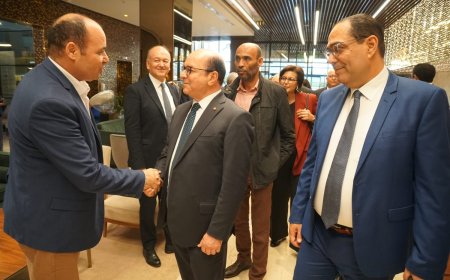
At the beginning of the official meetings, Ambassador Bassem Hassan received the high-level delegation at the Egyptian Embassy headquarters in Tunisia.
The meeting reflected official recognition of the importance of cultural diplomacy led by think tanks and intellectual institutions in strengthening brotherly relations among Arab states.
The in-depth discussions included a comprehensive review of the activities of the Universal Peace Message Foundation and Al-Arab Centre on both Arab and international levels, with particular emphasis on their role in dismantling extremist ideologies, combating radical discourse, and promoting peaceful coexistence.
Mr. Mohamed Fathi Elsherif presented the Ambassador with a comprehensive explanation of the Foundation’s enlightening intellectual project, which is based on promoting the values of mercy and humanitarian justice inspired by the Holy Quran.
For his part, Ambassador Bassem Hassan warmly welcomed the delegation and praised the significant intellectual efforts exerted by the Peace Message Foundation and Al-Arab Centre in enriching the intellectual library with rigorous publications. He affirmed that such initiatives contribute substantially to building enlightened awareness capable of protecting future generations and strengthening stability and intellectual security throughout the Arab region.
Intellectual Exchange with ALECSO Leadership
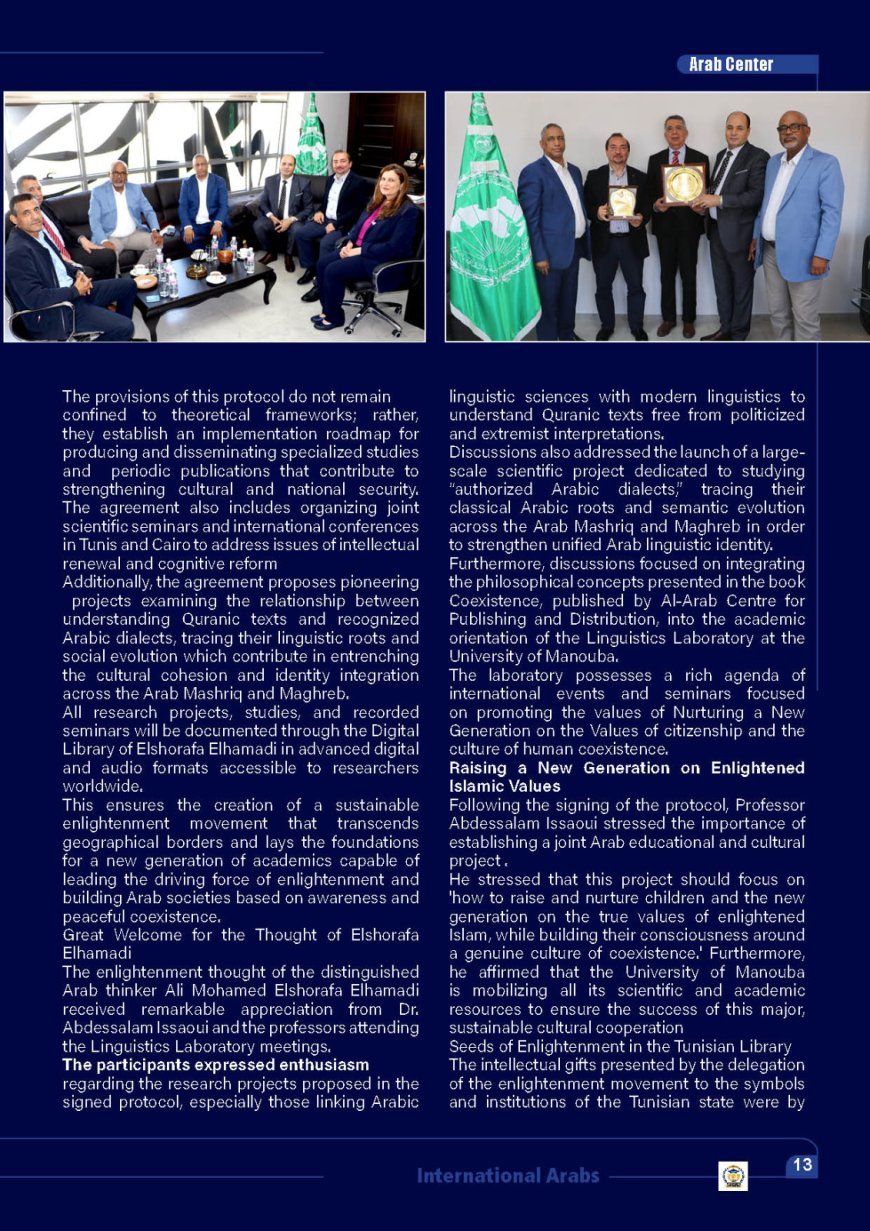
In an important intellectual and regional milestone, the delegation of the Foundation conducted a series of extensive meetings at the headquarters of Arab League Educational, Cultural and Scientific Organization (ALECSO) in Tunis.
Dr. Abdelhak Hayef, the Director of the Office of the Director-General of the Organization, received the delegation on behalf of Dr. Mohamed Ould Amar, the Director General of ALECSO.
The meeting witnessed deep consultations regarding mechanisms for spreading enlightenment culture among member states and methods for integrating moderate concepts into educational and cultural curricula in order to confront the intellectual expansion of extremist groups.
The delegation met Minister Plenipotentiary at the Arab League and Director of Education at the organization Ramy Eskander, Dr. Ahmed ELgalal, financial and administrative director at the organization, Ms. Nisreen Ghoneim, External Relations Officer at the organization.
These meetings culminated in an extensive session with Dr. Mohamed Sanad Abu Darwish, Director of the Science and Scientific Research Department at the organization.
The discussions focused on how scientific research, the humanities, and linguistics can be harnessed to dismantle extremist ideologies and develop unified Arab research platforms that support enlightenment thought grounded in dialogue and peaceful coexistence.
Dr. Mohamed Sanad Abu Darwish affirmed that the Department of Science and Scientific Research at ALECSO remains fully committed to supporting rigorous intellectual initiatives that serve Arab identity and promote scientific research toward a more open and stable future.
Media and Enlightenment: Discussions with ASBU
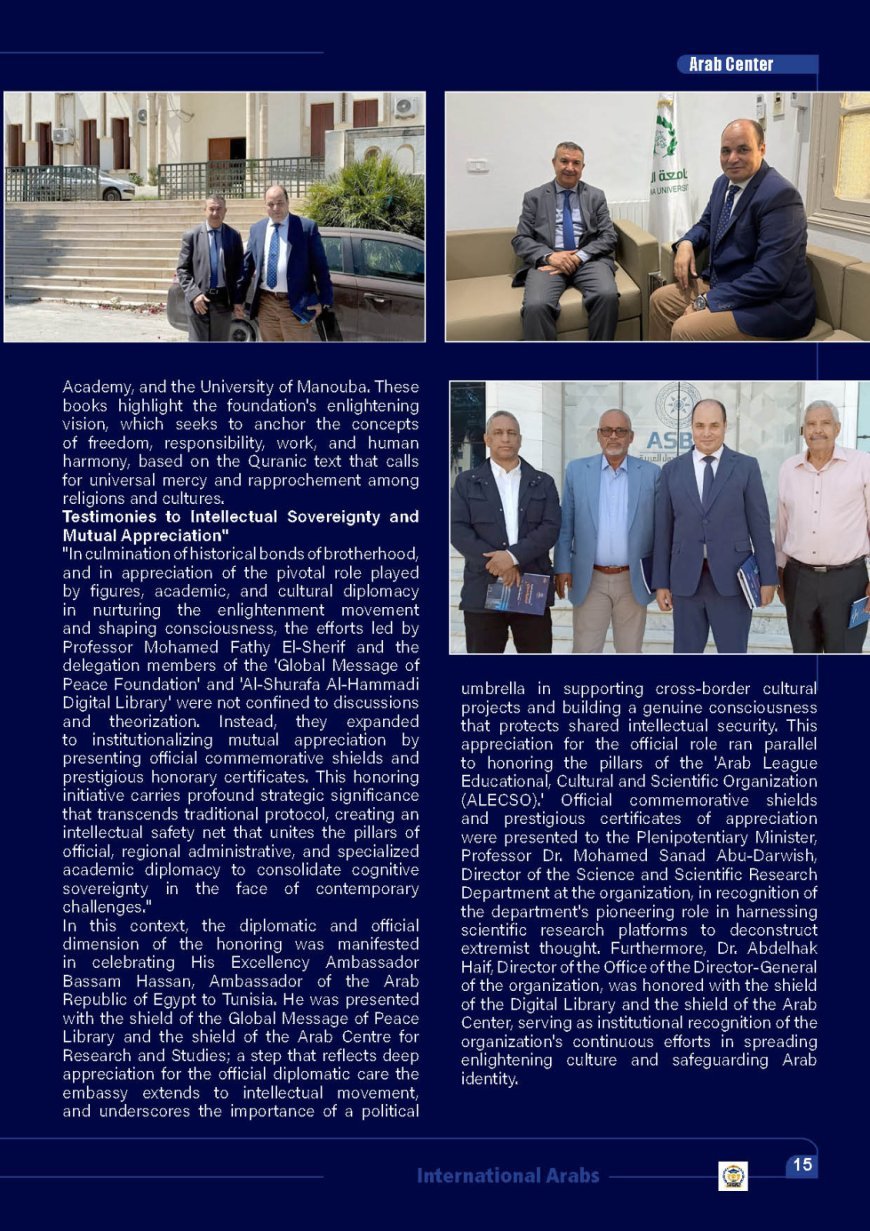
Based on the understanding that enlightenment thought requires powerful media platforms to reach the masses, journalist Mohamed Fathi Elsherif met Engineer Abdelrahim Soliman, Director-General of the Arab States Broadcasting Union (ASBU), at its headquarters in Tunis.
Both parties discussed ways to enhance media and intellectual cooperation, as well as mechanisms for activating the role of visual, audio, and digital media in supporting enlightenment causes and building Arab public awareness.
Elsherif presented the strategic vision of Al-Arab Centre for Research and Studies, highlighting the Centre’s publications and analytical contributions aimed at providing objective and in-depth analyses of regional and international issues that support decision-making and Arab public opinion.
He also highlighted the Digital Library of Elshorafa Elhamadi and its qualitative projects, including the “Audiobook” initiative, emphasizing the role of digital platforms in preserving and digitizing cultural heritage while making it accessible to media professionals and intellectuals in line with technological development.
Engineer Abdelrahim Soliman welcomed this vision and stressed ASBU’s commitment to supporting media content that carries enlightened and purposeful messages. He also emphasized the importance of integration between think tanks and media institutions in presenting balanced narratives capable of confronting contemporary intellectual challenges.
Soft Power and Development: Meeting with the Tunisian Minister of Tourism
As part of its exploration of the relationship between culture and development, the Foundation's delegation, led by Mr. Mohamed Fathi Elsherif and Haj Mohamed AlAmin, met with Sofiane Takia, the Tunisian Minister of Tourism.
The meeting focused on supporting cultural and cognitive tourism between Tunisia and the broader Arab region, while reinforcing Arab cultural identity through tourism and intellectual exchange.
Elsherif presented the strategies and initiatives of Al-Arab Centre, the Universal Peace Message Foundation, and the Digital Library of Elshorafa Elhamadi, explaining how digital and cognitive platforms can contribute to showcasing the bright civilizational image of the Arab and Islamic world.
Minister Sofiane Takia praised these efforts and highlighted the importance of integrating cultural and tourism dimensions. He affirmed that Tunisia remains open to initiatives that strengthen cognitive and humanitarian communication among Arab nations through the soft power of intellectual institutions.
Agreements and Cooperation Protocols: Institutionalizing Sustainable Thought
The delegation’s tour did not stop at friendly discussions and official meetings. Rather, it sought to institutionalize cultural cooperation and transform it into sustainable scientific and academic projects.
This initiative marked a significant milestone that captured the attention of the Tunisian academic community, as the delegation signed a series of important cooperation agreements, detailed as follows:
A Cooperation Protocol with Manouba University and the Arabic Language Academy
During its visit to the Faculty of Arts and the Linguistics Laboratory at Manouba University, the visiting delegation signed a cooperation protocol that embodied a unique research partnership between independent intellectual soft-power institutions and long-established academic entities.
The first party represented pioneering institutions dedicated to building awareness, promoting enlightened thought, and digitizing cognitive heritage. These included the Universal Peace Message Foundation, Al-Arab Centre for Research and Studies through its analytical and publishing arm, and the Digital Library of Al-Shorafa Elhamadi with its advanced technological platforms, and Universal Peace Message Foundation all of which carry a message of intellectual renewal and cultural reform.
The second party represented one of the most significant centers of humanitarian and linguistic thought in the Arab Maghreb — the Faculty of Letters, Arts, and Humanities at the University of Manouba, alongside the Postgraduate Linguistics Laboratory headed by Dr. Abdessalam Issaoui, member of Arabic Language Academy in Tunisia
The broad participation of Tunisian researchers and professors gave the agreement significant academic credibility, ensuring the transformation of enlightenment ideas into scientific research, academic curricula, and scholarly studies that meet the highest standards of linguistic and intellectual analysis which guarantee formulating a cognitive content characterized by depth, eternity and marketability in international academic circles .
Scientific and Linguistic Approaches to Deconstructing Extremist Discourse
The strategic pillar of this protocol is based on employing modern linguistics, with its various analytical and semantic branches, as a scientific tool for deconstructing the structure of extremist discourse produced over decades by political Islamist movements and groups advocating intellectual extremism.
The agreement includes launching joint research projects based on discourse analysis, tracing semantic transformations of concepts manipulated by extremist groups, and restoring them to their authentic Quranic and humanitarian contexts, in harmony with the vision of Ali Mohamed Elshorafa Elhamad
Through this cooperation, researchers at the Linguistics Laboratory of Manouba University will work on studying intellectual and heritage texts and purifying them from politicized interpretations. The initiative also seeks to demonstrate how the Arabic language sciences, when applied through objective methodologies, can highlight the values of universal mercy, responsible freedom, citizenship, and freedom of thought. This approach will provide researchers and young generations with rigorous linguistic and scientific evidence capable of refuting the fragile arguments of obscurantist ideologies and preventing extremist groups from exploiting religious emotions and decontextualized texts outside their authentic meanings and historical contexts.
The provisions of this protocol do not remain confined to theoretical frameworks; rather, they establish an implementation roadmap for producing and disseminating specialized studies and periodic publications that contribute to strengthening cultural and national security. The agreement also includes organizing joint scientific seminars and international conferences in Tunis and Cairo to address issues of intellectual renewal and cognitive reform
Additionally, the agreement proposes pioneering projects examining the relationship between understanding Quranic texts and recognized Arabic dialects, tracing their linguistic roots and social evolution which contribute in entrenching the cultural cohesion and identity integration across the Arab Mashriq and Maghreb.
All research projects, studies, and recorded seminars will be documented through the Digital Library of Elshorafa Elhamadi in advanced digital and audio formats accessible to researchers worldwide.
This ensures the creation of a sustainable enlightenment movement that transcends geographical borders and lays the foundations for a new generation of academics capable of leading the driving force of enlightenment and building Arab societies based on awareness and peaceful coexistence.
Great Welcome for the Thought of Elshorafa Elhamadi
The enlightenment thought of the distinguished Arab thinker Ali Mohamed Elshorafa Elhamadi received remarkable appreciation from Dr. Abdessalam Issaoui and the professors attending the Linguistics Laboratory meetings.
The participants expressed enthusiasm regarding the research projects proposed in the signed protocol, especially those linking Arabic linguistic sciences with modern linguistics to understand Quranic texts free from politicized and extremist interpretations.
Discussions also addressed the launch of a large-scale scientific project dedicated to studying “authorized Arabic dialects,” tracing their classical Arabic roots and semantic evolution across the Arab Mashriq and Maghreb in order to strengthen unified Arab linguistic identity.
Furthermore, discussions focused on integrating the philosophical concepts presented in the book Coexistence, published by Al-Arab Centre for Publishing and Distribution, into the academic orientation of the Linguistics Laboratory at the University of Manouba.
The laboratory possesses a rich agenda of international events and seminars focused on promoting the values of Nurturing a New Generation on the Values of citizenship and the culture of human coexistence.
Raising a New Generation on Enlightened Islamic Values
Following the signing of the protocol, Professor Abdessalam Issaoui stressed the importance of establishing a joint Arab educational and cultural project .
He stressed that this project should focus on 'how to raise and nurture children and the new generation on the true values of enlightened Islam, while building their consciousness around a genuine culture of coexistence.' Furthermore, he affirmed that the University of Manouba is mobilizing all its scientific and academic resources to ensure the success of this major, sustainable cultural cooperation
Seeds of Enlightenment in the Tunisian Library
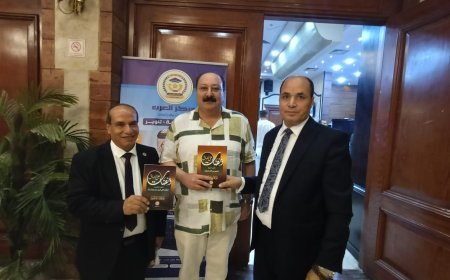
The intellectual gifts presented by the delegation of the enlightenment movement to the symbols and institutions of the Tunisian state were by no means a passing, protocol-driven initiative. Rather, they represented the offering of an integrated and interconnected intellectual system, shaped by the prominent Arab thinker Ali Muhammad Al-Shurafa Al-Hammadi, alongside the international and Arabic editions of Al-Arab Journal for Research and Studies. Together, these publications form an analytical resource that seeks to rebuild consciousness and safeguard cognitive sovereignty. These works derive their depth from their capacity to provide systemic treatments that deconstruct crises of faith, coexistence, and religious reform at their deepest structural levels—a reality clearly manifested in the four scholarly theses included in these gifts.
From the perspective of the 'structural reform of religious discourse,' the book A Document on Islam emerges as a primary cornerstone. It aims to re-anchor the concepts of the governing Quranic reference and freedom of belief, by purging Islamic thought of the politicized exegetical narratives that were imposed upon it and caused the fragmentation of the nation. Theoretically and contextually, this approach aligns with the book The Message of Islam: Mercy, Freedom, Work, and Peace, which handles the anatomical deconstruction of extremist and intolerant discourses. It re-highlights the human dimension of the divine message, proving that the values of human production, responsible freedom, and social peace are the core objectives of Sharia (Maqasid) that In the context of 'building humanitarian bridges across sects and religions,' the book The Quran Testifies to the Validity of the Christian Faith comes forward to represent a brave and qualitative leap in the theology of dialogue and rapprochement between religions and cultures. Here, the author relies on the decisive Quranic texts to prove the divine affection directed toward the People of the Book, rejecting theories of religious conflict and excommunication (Takfir). This intellectual system culminates in the book Coexistence, which transcends the boundaries of direct religious discourse to formulate a 'comprehensive philosophical and social equation' that establishes harmony and rapprochement between the peoples of the Arab Mashriq and Maghreb. It considers true peace and mutual recognition of identities to be the primary engines for building an enlightened Arab bloc capable of confronting contemporary challenges and protecting its societies from internal erosion and intellectual invasion."have been overshadowed by extremist ideologies.
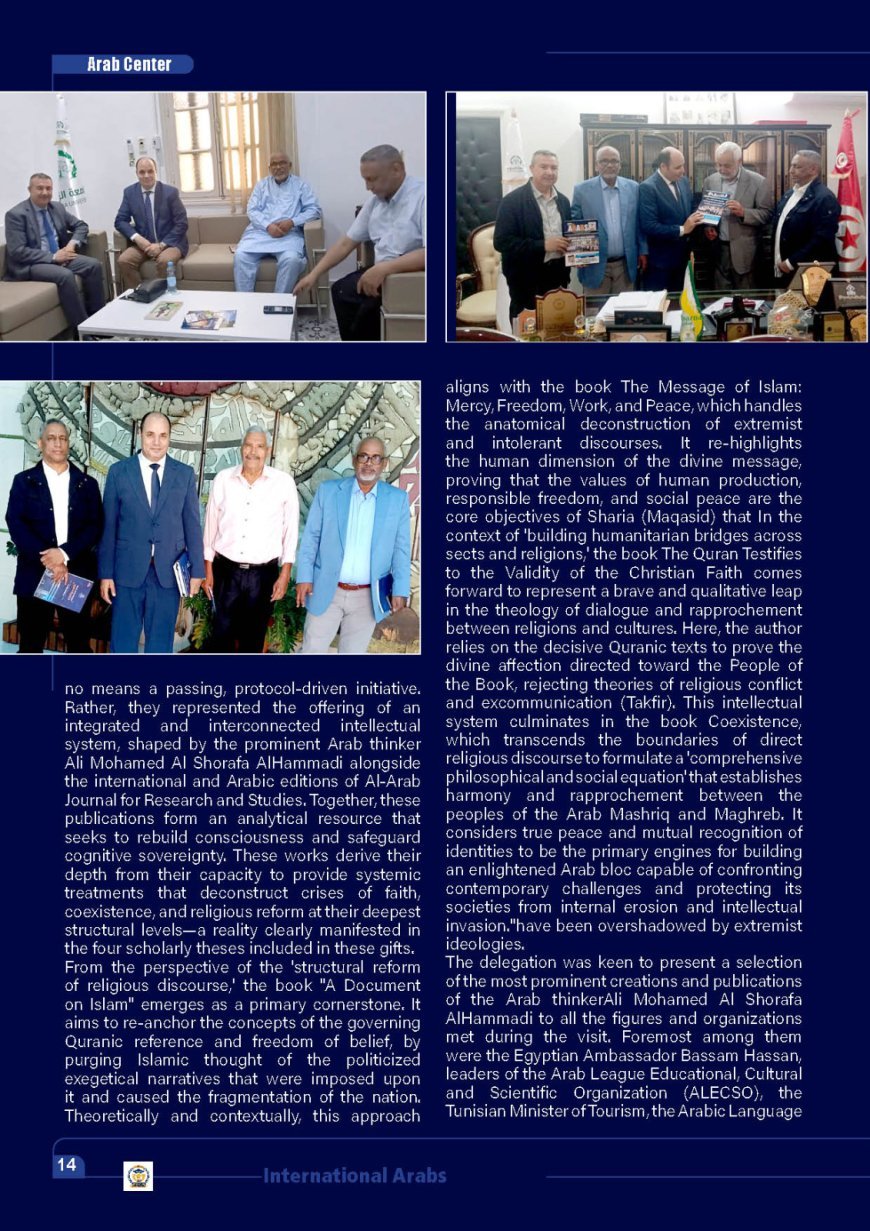
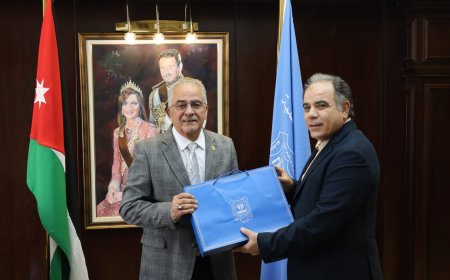
The delegation was keen to present a selection of the most prominent creations and publications of the Arab thinker Ali Muhammad Al-Shurafa Al-Hammadi to all the figures and organizations met during the visit. Foremost among them were the Egyptian Ambassador Bassam Hassan, leaders of the Arab League Educational, Cultural and Scientific Organization (ALECSO), the Tunisian Minister of Tourism, the Arabic Language Academy, and the University of Manouba. These books highlight the foundation's enlightening vision, which seeks to anchor the concepts of freedom, responsibility, work, and human harmony, based on the Quranic text that calls for universal mercy and rapprochement among religions and cultures.
Testimonies to Intellectual Sovereignty and Mutual Appreciation"
"In culmination of historical bonds of brotherhood, and in appreciation of the pivotal role played by figures, academic, and cultural diplomacy in nurturing the enlightenment movement and shaping consciousness, the efforts led by Professor Mohamed Fathy El-Sherif and the delegation members of the 'Global Message of Peace Foundation' and 'Al-Shurafa Al-Hammadi Digital Library' were not confined to discussions and theorization. Instead, they expanded to institutionalizing mutual appreciation by presenting official commemorative shields and prestigious honorary certificates. This honoring initiative carries profound strategic significance that transcends traditional protocol, creating an intellectual safety net that unites the pillars of official, regional administrative, and specialized academic diplomacy to consolidate cognitive sovereignty in the face of contemporary challenges."
In this context, the diplomatic and official dimension of the honoring was manifested in celebrating His Excellency Ambassador Bassam Hassan, Ambassador of the Arab Republic of Egypt to Tunisia. He was presented with the shield of the Global Message of Peace Library and the shield of the Arab Centre for Research and Studies; a step that reflects deep appreciation for the official diplomatic care the embassy extends to intellectual movement, and underscores the importance of a political umbrella in supporting cross-border cultural projects and building a genuine consciousness that protects shared intellectual security. This appreciation for the official role ran parallel to honoring the pillars of the 'Arab League Educational, Cultural and Scientific Organization (ALECSO).' Official commemorative shields and prestigious certificates of appreciation were presented to the Plenipotentiary Minister, Professor Dr. Mohamed Sanad Abu-Darwish, Director of the Science and Scientific Research Department at the organization, in recognition of the department's pioneering role in harnessing scientific research platforms to deconstruct extremist thought. Furthermore, Dr. Abdelhak Haif, Director of the Office of the Director-General of the organization, was honored with the shield of the Digital Library and the shield of the Arab Center, serving as institutional recognition of the organization's continuous efforts in spreading enlightening culture and safeguarding Arab identity.